
Date: 2026-08-20
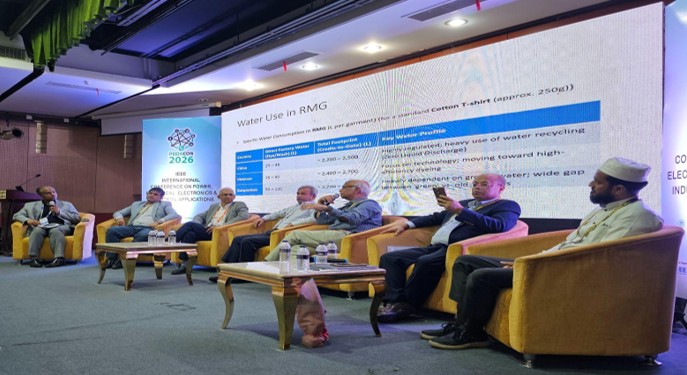
A high-level panel discussion titled “Powering Bangladesh: A Strategic Energy Plan for Resilient Energy Security” was held on 6 August 2026 at 11:00 AM at the Prof. Dr. M. H. Khan Auditorium, Ahsanullah University of Science and Technology (AUST). The session brought together distinguished academicians, policymakers, researchers, regulators, and professionals from Bangladesh’s power and energy sector to discuss the country’s future energy requirements, grid resilience, generation planning, and long-term energy security.
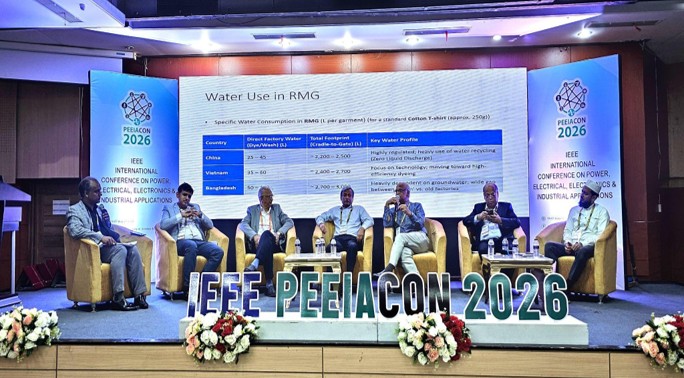
The session was organized as part of the IEEE International Conference on Power, Electrical, Electronics & Industrial Applications (PEEAICon 2026) and provided a platform for sharing expert perspectives on the challenges and opportunities associated with Bangladesh’s evolving energy landscape.
Distinguished Panel
Dr. Abdul Hasib Chowdhury, Professor, Department of Electrical and Electronic Engineering (EEE), Bangladesh University of Engineering and Technology (BUET), served as the Panel Keynote Speaker. He presented key perspectives on the strategic measures required to develop a resilient, efficient, and sustainable power system capable of supporting Bangladesh’s future economic growth.
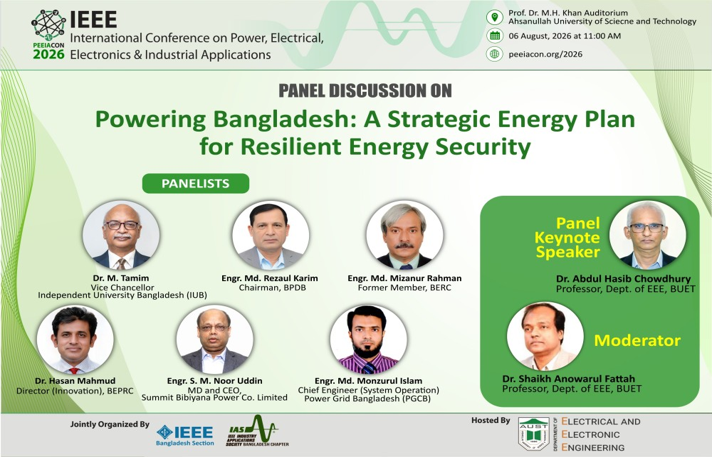
The discussion featured distinguished experts representing academia, regulatory and research organizations, power generation, and national grid operation.
The honorable discussants were Prof. Dr. M. Tamim, Vice Chancellor, Independent University, Bangladesh (IUB); Engr. Md. Mizanur Rahman, Former Member, Bangladesh Energy Regulatory Commission (BERC); Dr. Hasan Mahmud, Director (Innovation), Bangladesh Energy and Power Research Council (BEPRC); Engr. S. M. Nooruddin, Managing Director and CEO, Summit Bibiyana Power Co. Limited; and Engr. Md. Monzurul Islam, Chief Engineer (System Operation), Power Grid Bangladesh (PGCB).
The session was moderated by Dr. Shaikh Anowarul Fattah, Professor, Department of EEE, Bangladesh University of Engineering and Technology (BUET).
Addressing Bangladesh’s Future Energy Requirements
The panel discussion focused on the strategic transformation required in Bangladesh’s power and energy sector as the country moves toward a significantly larger economy. With Bangladesh targeting a USD 1 trillion economy by the mid-2030s, continued economic expansion is expected to create substantial growth in electricity and overall energy demand.
The discussion highlighted projections suggesting that annual electricity generation requirements could reach approximately 150–170 TWh, with peak demand approaching 25–28 GW. Meeting such demand may require an installed generation capacity of around 35–40 GW, together with corresponding improvements in transmission, distribution, system operation, and supporting infrastructure.
The panelists emphasized that future energy planning must consider changing patterns of energy consumption across industry, agriculture, transportation, and other major economic sectors. Coordinated planning based on future sectoral demand and energy intensity will therefore be essential for ensuring reliable and sustainable energy supply.
Strengthening National Grid Resilience
A major focus of the discussion was the changing technical characteristics of the Bangladesh Power System. The growing share of non-synchronous energy sources—including solar photovoltaic generation, reciprocating engine-based plants, and certain HVDC electricity imports—introduces new challenges for frequency control and system stability.
A considerable portion of installed capacity does not provide the inherent rotational inertia traditionally available from large synchronous generators. As a result, sudden generation losses or disturbances can lead to rapid frequency deviations and increase the complexity of maintaining stable grid operation.
The panel also discussed the limitations associated with the country’s weakly meshed and partially radial transmission network, particularly where electricity is transmitted through long corridors. Such conditions can increase vulnerability to localized disturbances, cascading outages, protection relay miscoordination, and wider system instability.
Enhancing primary frequency response, improving protection and operational coordination, and developing a more interconnected and strongly meshed transmission network were highlighted as important measures for strengthening the resilience of the national grid.
Climate Resilience and Resource Diversification
Climate-related vulnerabilities were also an important part of the discussion. Bangladesh’s future energy infrastructure must be capable of responding to increasingly complex environmental stresses, including extreme weather events and climate phenomena such as El Niño.
The panel emphasized the importance of resource diversification, climate-resilient infrastructure, agricultural electrification, and improved energy efficiency. These measures can contribute to greater energy security while simultaneously supporting economic productivity and sustainable development.
Bangladesh’s high population density and limited availability of land were also identified as major considerations in long-term power-sector planning. Expanding conventional generation and transmission infrastructure requires significant land resources, making efficient land utilization increasingly important. In this context, rooftop solar, distributed generation, and high-density energy solutions can provide additional opportunities for expanding electricity supply.
Towards a Resilient and Sustainable Energy Future
The discussion emphasized that Bangladesh’s future energy security will depend not only on increasing generation capacity but also on developing a coordinated and technically robust energy strategy. Generation diversification, transmission modernization, improved grid stability, climate resilience, efficient land utilization, distributed energy resources, and sector-specific demand planning will all be critical components of that strategy.
By bringing together experts from academia, research organizations, regulatory institutions, power generation companies, and grid operations, the panel discussion provided a valuable forum for examining the country’s energy challenges from multiple technical and strategic perspectives.
The session highlighted the importance of developing a reliable, resilient, technologically advanced, and sustainable national energy system capable of supporting Bangladesh’s long-term economic aspirations while effectively addressing future operational, environmental, and resource-related challenges.
The event was jointly organized by the IEEE Bangladesh Section and the IEEE Industry Applications Society (IAS) Bangladesh Chapter and hosted by the Department of Electrical and Electronic Engineering, Ahsanullah University of Science and Technology (AUST).
141 & 142, Love Road, Tejgaon Industrial Area, Dhaka-1208.
Tel. (8802) 8870422, Ext. 107, 114, Fax : (8802) 8870418
Email : info@aust.edu, regr@aust.edu