
Department of
Date: 2026-09-21
The AUST Civil Engineering Society (ACES) organized a seminar titled “Sustainable Solutions to Traffic Congestion in Dhaka City” on September 21, 2026, at M.H. Khan auditorium. The honourable Chief Guest, Prof. Dr. Md. Ashraful Hoque, Vice Chancellor of AUST, and the Special Guest, Prof. Dr. Sharmin Reza Chowdhury, Treasurer & Pro-Vice Chancellor (In-Charge), AUST, graced the event with their presence. Prof. Dr. Fatema-Tuz-Zahura, the Head of the Department of Civil Engineering, presided over the event as its chair. The program was further enriched by the participation of several faculty members who played significant roles in ensuring the success of the event.
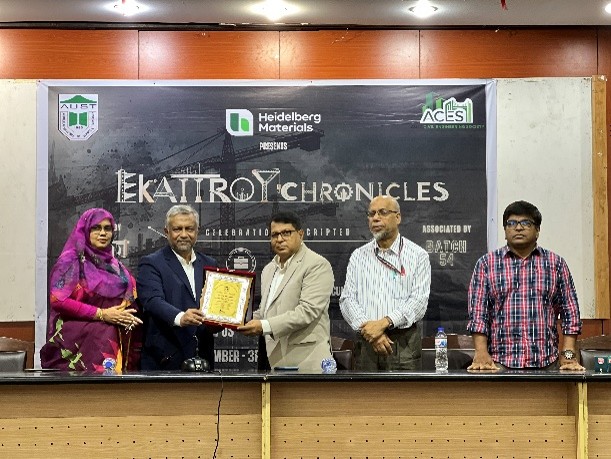
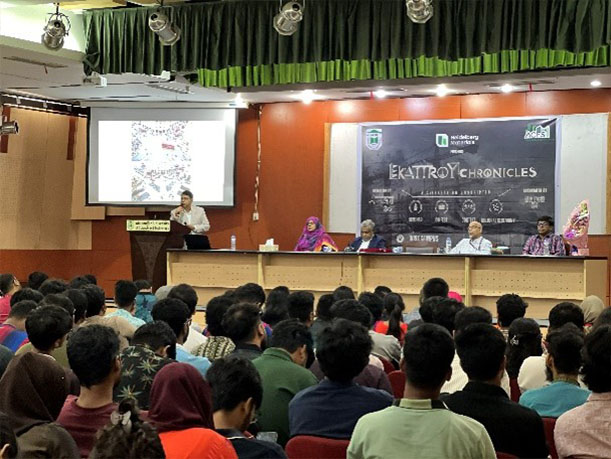
The program started with a speech by Prof. Dr. Md. Abdul Matin, who praised the keynote speaker for his many contributions to the education sector and transportation system of Bangladesh. Moreover, he shared his insightful remarks on the importance of bridging theoretical knowledge gained in the classroom with practical engineering applications in the field. The Special Guest, Prof. Dr. Sharmin Reza Chowdhury, then addressed the gathering and emphasized the significance of sustainable solutions to problems that affect our lives daily, such as traffic congestion. He highlighted how attending such seminars can complement academic learning, especially FYDP projects for students, and provide future engineers with a deeper understanding of the responsibilities and challenges involved in sustainable solutions.
Prof. Dr. Md. Ashraful Hoque, Vice-Chancellor of AUST, delivered an encouraging address emphasizing the university’s continued commitment to academic excellence, practical learning, and the overall professional development of its students. He shared some of his experience with various traffic-related problems in Dhaka city, and how the keynote speaker’s efforts and views are helping to develop the minds of future engineers to tackle these problems. Prof. Dr. Fatema-Tuz-Zahura commended the organizers for arranging such a valuable and informative seminar. She also offered words of guidance and encouragement to the students, inspiring them to make the most of opportunities for learning beyond the classroom.
Next, an insightful, thought-provoking, and technically compelling presentation was delivered by Prof. Dr. Shamsul Hoque, a revered and distinguished professor at Bangladesh University of Engineering and Technology, specializing in transportation engineering. Dr. Hoque began by highlighting the importance of pedestrian-oriented urban infrastructure and adequately wide footpaths, drawing attention to international examples such as Oxford Street and several streets in Singapore where pedestrian space is given a prominent share of the urban right-of-way. He then presented a critical perspective on conventional supply-side, car-oriented transport planning, particularly the approach of continuously increasing road capacity through additional lanes, flyovers, and other infrastructure to accommodate growing automobile use. In contrast, he advocated a demand-based and public-transport-oriented approach, emphasizing the superior passenger-carrying efficiency of buses and mass-transit systems such as BRT and MRT, which can transport significantly more people while occupying far less road space per passenger. He further emphasized a push-and-pull approach: discouraging private-car dependence through road-use restrictions or charges while simultaneously improving the attractiveness of public transport through greater comfort, reliability, and affordability. The presentation offered a compelling perspective on how Dhaka can move from automobile-dependent mobility toward a more sustainable, efficient, and people-centered urban transport system. The presentation was followed by an interactive session where students and participants took part in addressing various queries.
The program also featured a formal Crest-Giving Ceremony, during which tokens of respect and appreciation were presented to the distinguished guests and the keynote speaker in recognition of their valuable contributions to the event. The seminar concluded with a formal vote of thanks delivered by the organizers, expressing sincere gratitude to the Chief Guest, Special Guest, keynote speaker, faculty members, and student participants for their valuable presence, support, and contribution to making the seminar a meaningful and successful event.
Faculty of Engineering
Ahsanullah University of Science and Technology
141 & 142, Love Road, Tejgaon Industrial Area, Dhaka-1208
Tel. (8802) 8870422, Ext. 107, 114, Fax : (8802) 8870418
Email: info@aust.edu, regr@aust.edu