

Department of
Date: 2026-10-01
The Department of Architecture at Ahsanullah University of Science and Technology (AUST) marked its 30th anniversary with a day-long seminar bringing together distinguished architects, academics, practitioners, alumni, and students to explore the future of the profession. Held on 3rd July 2026 at the MH KHAN AUDITORIUM, AUST campus in Dhaka, the seminar titled 'Bridging Generations: The Future We Build' was organized in two distinctive sessions.
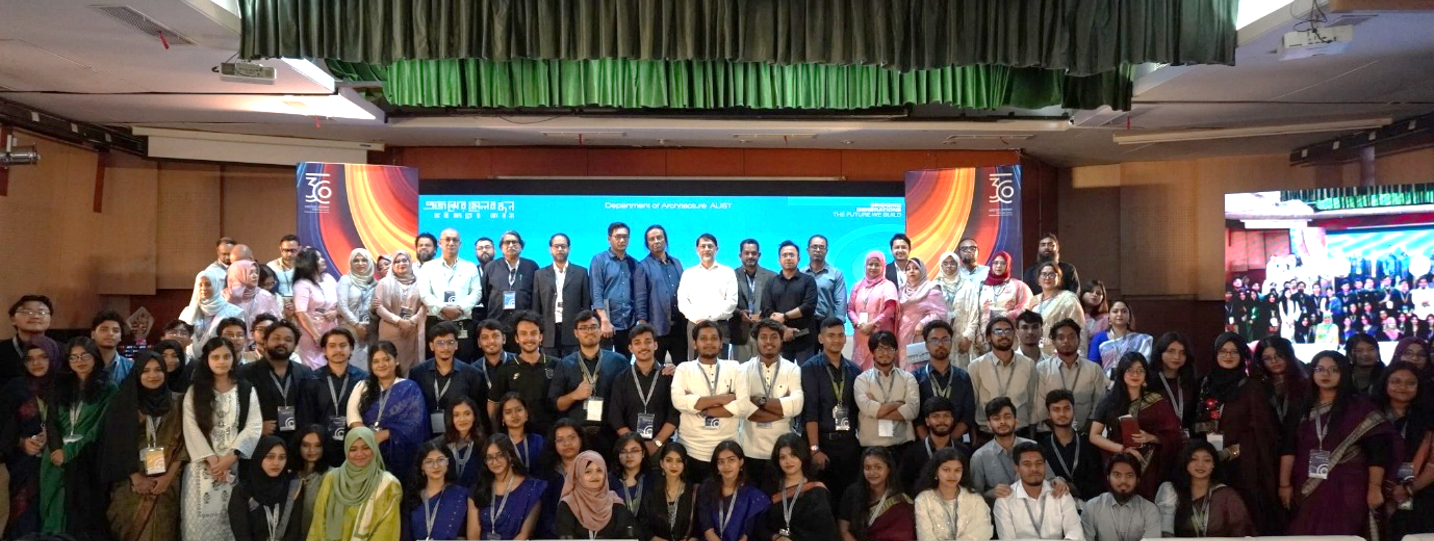
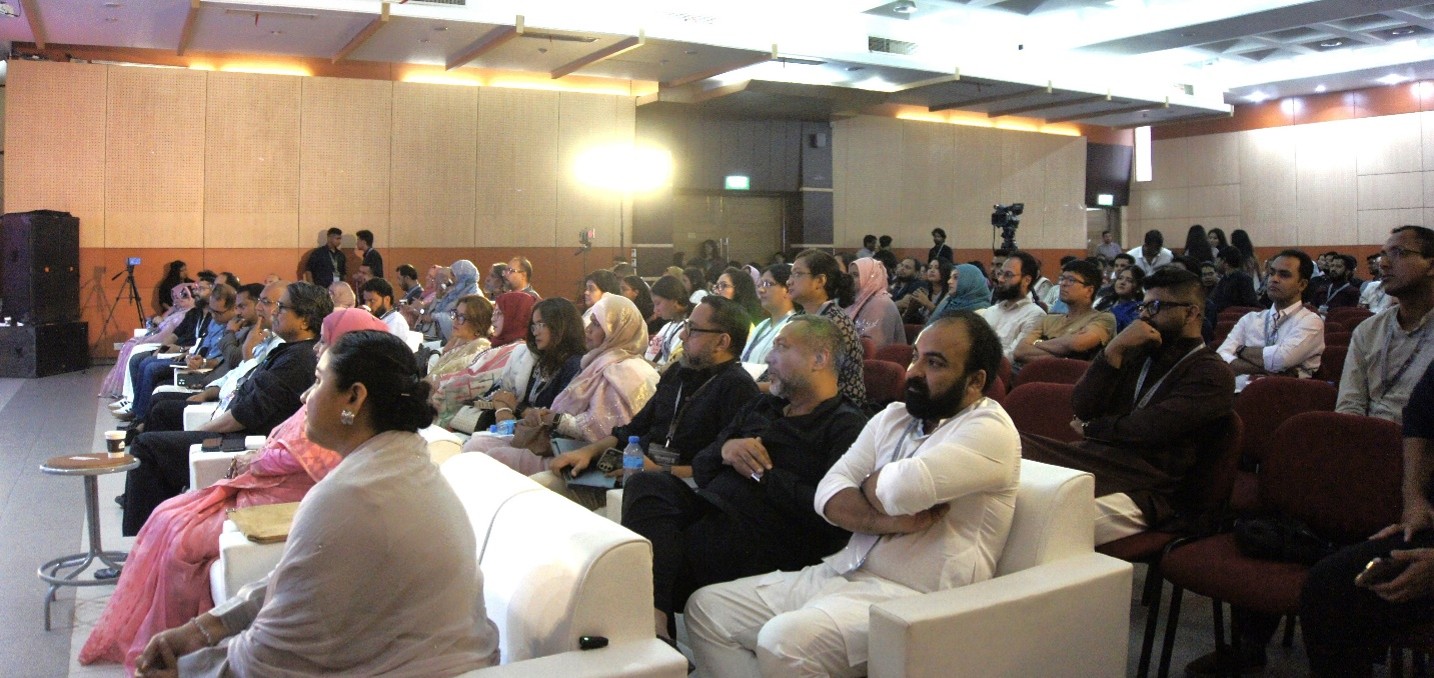
Session I: Future Academia - Directions for Architectural Education
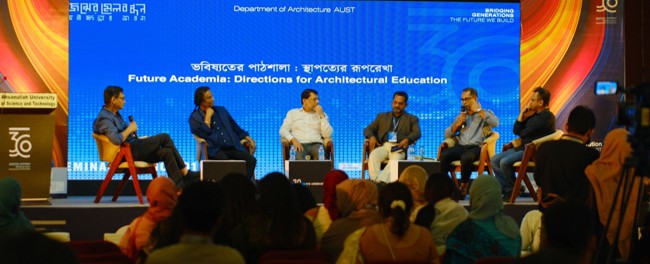
The first session posed a central question: how must architectural education evolve to meet the pressures of climate change, technological disruption, and shifting social priorities? Five distinguished speakers- including an invited speaker from Sri Lanka- addressed the audience in sequence, each contributing a distinct perspective on the future of the discipline.
The session explored the role of hand drawing in the age of AI, the place of cultural heritage in curricula, decolonial pedagogy, computational design, and environmental sensitivity as a foundational ethic of architectural practice.
Ar. Mustapha Khalid Palash FIAB, Int. Assoc. AIA | Principal Architect & Managing Director, Vistaara Architects | Editor, DOT
One of Bangladesh's most celebrated architects, Palash has shaped Dhaka's skyline over three and a half decades through projects including the Grameenphone Corporate Headquarters, Bashundhara City, and The Westin Dhaka. He trained under Tadao Ando and is a recipient of the IAB Design Award, the Holcim Green Built Prize, and the Shilpacharya Zainul Award for painting.
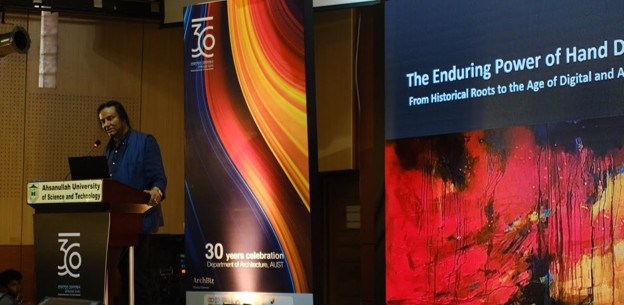
In his presentation -- 'The Enduring Power of Hand Drawing in Architectural Education: From Historical Roots to the Age of Digital and AI' -- Palash argued that hand drawing remains not a nostalgic relic but an irreplaceable cognitive instrument. As AI and generative tools reshape the studio, the future architect must be fluent in both the tactile intelligence of the hand and the computational power of digital systems -- grounding the latter firmly in the former.
Prof. Dr. Sharif Shams Imon | Professor & President, ICOMOS Bangladesh
An internationally recognised authority on architectural heritage management, Prof. Imon holds a PhD in Urban Conservation from the University of Hong Kong and has led UNESCO advisory and monitoring missions across more than 18 countries. He is an expert member of ICOMOS CIVVIH and authored the Core Competences chapter of UNESCO's global Competence Framework for Cultural Heritage Management.
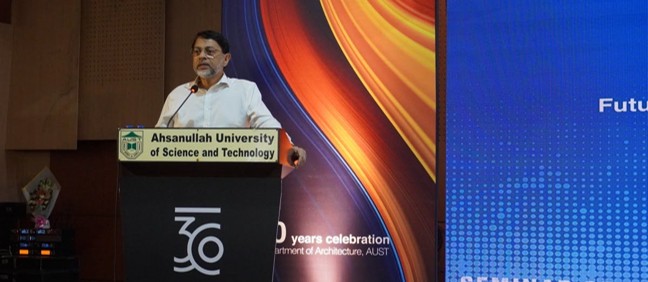
His presentation -- 'Cultural Heritage in Architecture Education in Bangladesh' -- argued for a fundamental reorientation of the curriculum. Drawing historical comparisons (Mahasthan predates imperial Rome; Paharpur predates the spread of Islam beyond Makkah), he challenged the field's inherited American academic bias and called for Bengal's rich architectural legacy to move from a peripheral history course into the living centre of design studio education.
Prof. Dr. Saiful Islam | Professor, Department of Architecture, North South University (NSU)
A AUST B.Arch alumnus and PhD graduate of Texas A&M University, Dr. Islam's research on green building strategies and thermal comfort in Dhaka's high-density residential fabric are recognized few.
His presentation -- 'Reimagining Architectural Pedagogy Through a Decolonial Lens' -- invited educators to examine the Eurocentric assumptions embedded in architectural teaching. Invoking James A. Banks' framework of transformative education, he called not for a reversal that privileges the East over the West, but for a genuine transformation: one that roots students in their own heritage while equipping them to engage critically with the global discipline.
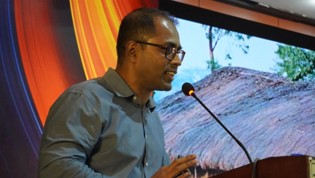

Ar. Ashik Vaskor Mannan | Senior Associate Professor, AIUB | Principal, Studio XI Architects
Holding a B.Arch from BUET and M.Arch from the DIA Bauhaus, Germany, Mannan has taught at AIUB since 2006 and conducts workshops internationally through the DigitalFUTURE computational design network.
His presentation - 'Instruments of Thought: Rethinking Architectural Education in the Age of Artificial Intelligence' -- offered a philosophical archaeology of architecture's relationship with its tools, from the Renaissance draftsman through CAD to AI. He argued that the designer's role is becoming curatorial -- selecting and composing within algorithmic abundance -- and called for a 'synthetic ecology' in the studio where hand, code, and critical thought coexist as instruments of a continuous act of designing.
Ar. Damith Premathilake AIA | RIBA | FIA(SL) | Invited International Speaker -- Sri Lanka
Ar. Premathilake holds professional memberships with the American Institute of Architects (AIA), the Royal Institute of British Architects (RIBA), and a Fellowship of the Institute of Architects of Sri Lanka (FIA-SL). His interdisciplinary formation spans building engineering, architecture, and landscape architecture, with a practice centred on environmental performance and nature-responsive design.
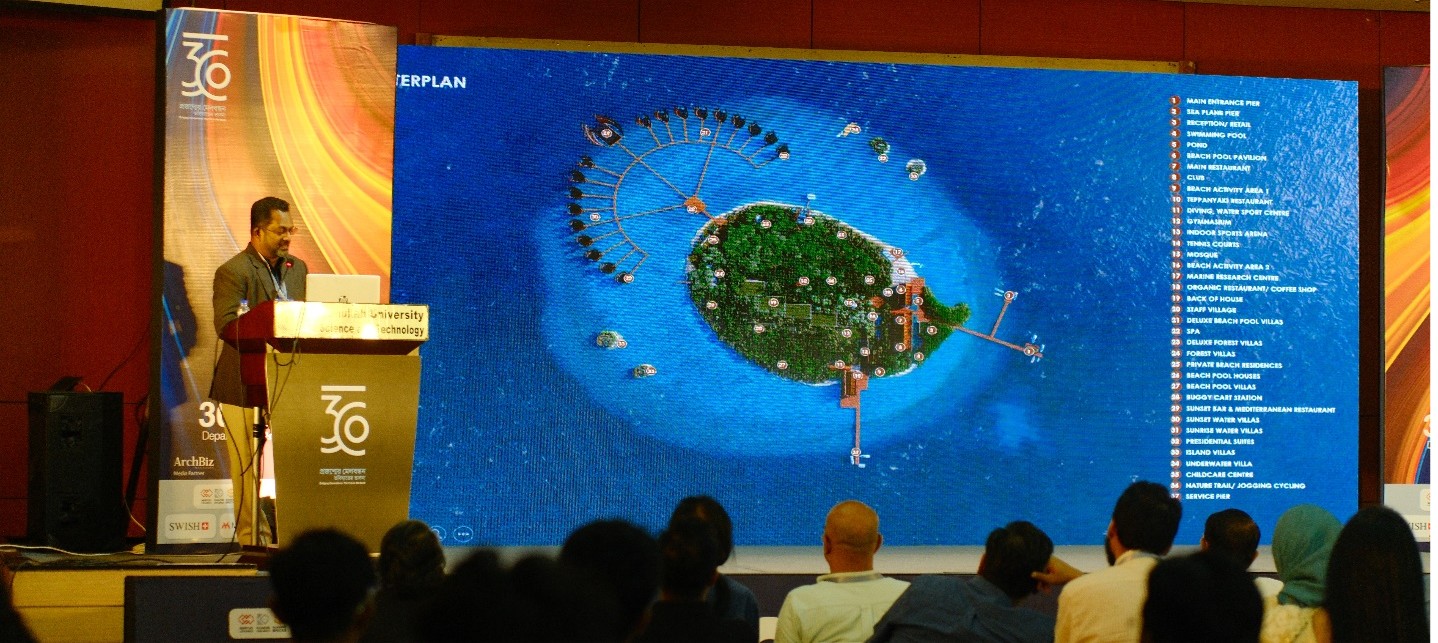
His presentation -- 'Learning to Design with Nature: Environmental Sensitivity in Architecture Education' -- argued that environmental sensitivity must become a foundational mindset woven throughout pedagogy, not an elective. He drew on vernacular architecture and context-specific traditions as invaluable strategies for resilience, and affirmed the continuing indispensability of direct observation and hand drawing for nurturing a meaningful understanding of place.
Plenary Session
Following the five presentations, a plenary discussion was facilitated by Ar. Mahmudul Anwar Riyaad -- Principal Designer and Director of DWm4 Intrends Ltd., BUET graduate, and holder of a Masters in Architectural Design from The Bartlett, UCL. A co-founder of DWm4 Architects and Brainstation-23, and a longtime contributor to the Institute of Architects Bangladesh, Riyaad drew connections across the session's threads -- between the analogue hand and the synthetic studio, between heritage pride and global engagement, between the urgency of decolonial reform and the practical demands of integrating AI into an educational context still building its critical foundations. The discussion drew contributions from students, faculty, and alumni, confirming the resonance of the session's themes well beyond the podium.
Crest Handover
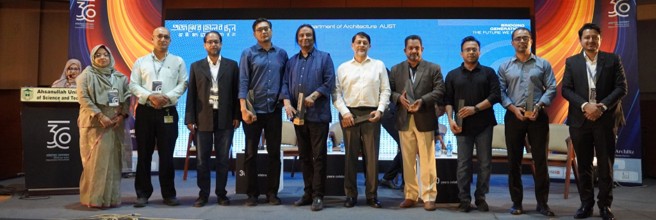
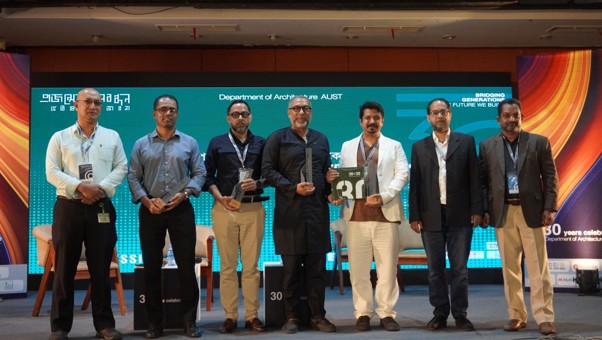
At the close of the morning session, the Seminar Committee along with the Head of the Department of Architecture presented honorary crests to each of the distinguished speakers in recognition of their contributions to the day's programme and to the broader field of architectural education. The ceremony was attended by faculty, students, and guests, and reflected the spirit of gratitude and collegiality that marks the Department's 30th anniversary.
The first session concluded with the lunch break and Jumu’ah prayer. All participants, guests, alumni, students, and faculty were warmly invited to reconvene for Session II of the day-long seminar in the afternoon.
Session II: Journey of Architecture - From Learning to Practice
The second session turned from the future of architectural education to the lived journey beyond the studio-asking how the knowledge, values, and ways of thinking cultivated at AUST evolve through professional practice. Titled “Journey of Architecture: From Learning to Practice,” the session brought together three distinguished AUST alumni whose diverse professional trajectories reflect the many ways architectural education can translate into practice, research, teaching, and built work. The discussion explored the relationship between academic ideals and professional realities, with particular attention to context, vernacular knowledge, sustainability, technical constraints, and the continuous process of learning through practice.
Ar. Zishan Fuad Choudhury | Assistant Professor, Department of Architecture, AUST
An AUST B.Arch graduate of 2004, Zishan Fuad Choudhury pursued postgraduate studies in EU-Urbanism at Bauhaus Kolleg Dessau, Germany. Alongside teaching at AUST since 2011, he has remained engaged in professional practice, with his interests shaped by extensive travel and an engagement with modern architecture, historic cities, and their histories.
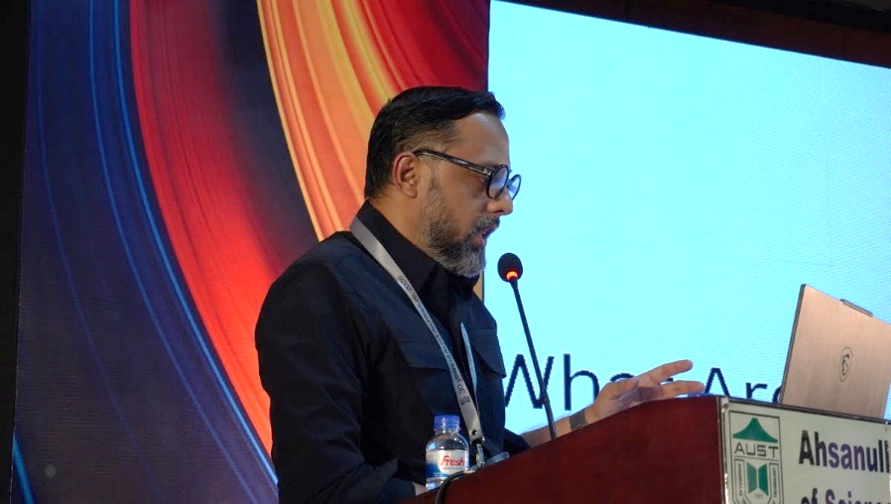
His presentation-“Designing for Context: Translating Studio Ideals into Built Realities”-examined the challenging transition from architectural education to professional practice. Drawing on selected projects, he explored how ideas of space, scale, proportion, light, circulation, and human interaction developed in the academic studio are transformed through encounters with complex sites, client expectations, materials, and construction realities. The presentation highlighted contextual responsiveness, functionality, social responsibility, adaptability, and persistence as continuing principles through which architectural intentions are translated into built outcomes.
Ar. Ruqun Uddin Bhuiya | Principal Architect, Metropolitan Architects
An AUST graduate who later pursued advanced architectural studies in the United States, Ruqun Uddin Bhuiya is a practicing architect whose work explores the relationship between rural vernacular traditions and contemporary design. His practice places particular emphasis on ecological balance, contextual sensitivity, and the integration of water and greenery into contemporary living environments.
His presentation-“From Southern Bengal’s Vernacular to Modern Living: An Architectural Journey”-reflected on the influence of growing up in a rural town along the Boleshor River and encountering the craftsmanship of local Hindu Pal artisans. Drawing from these early experiences of material, water, landscape, and craft, he traced the development of an architectural approach that brings together the spatial intimacy and climatic responsiveness of southern Bengal's vernacular traditions with contemporary design. The presentation explored how local knowledge and cultural memory can inform sustainable and human-centred modern habitats.
Ar. Md. Shafiul Azam Shamim | Managing Director & Principal Architect, Arquitectura Pvt. Ltd.
An AUST graduate and co-founder of Arquitectura Pvt. Ltd., Shafiul Azam Shamim has more than 15 years of professional experience and has led projects across Bangladesh spanning high-rise, healthcare, institutional, industrial, military, and RMG-sector developments. He has pursued advanced studies in housing design at TU Delft and green building at BUET, and has also served on the Executive Council of the Institute of Architects Bangladesh and as an Adjunct Faculty member at AUST. His work also extends to climate resilience, community equity, and the advancement of young architects across Asia.
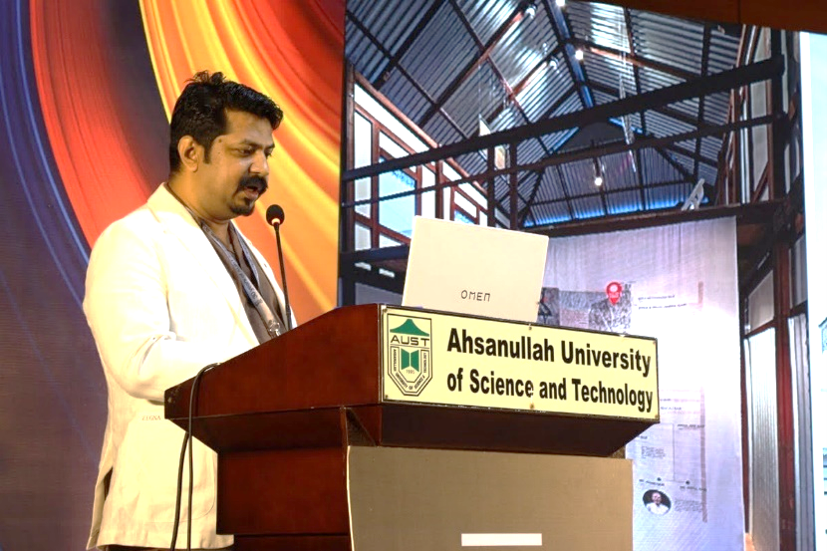
His presentation-“Journey of Architecture: From Learning to Practice”-examined the continuous dialogue between architectural education and professional practice. Drawing on fifteen years of experience and a selected project, he explored how academic ideas encounter the realities of building regulations, land-use restrictions, budgets, client aspirations, site conditions, and stakeholder needs. The presentation demonstrated how climate analysis, site systems, planning strategies, and design thinking are negotiated within practical constraints, ultimately framing architecture as an ongoing cycle of learning, creating, and relearning.
Plenary Session
The session was moderated by Dr. Saiful Islam, Professor at the Department of Architecture, North South University (NSU), and an AUST B.Arch alumnus. Dr. Islam holds a Ph.D. from Texas A&M University and an M.Arch. from the University of Texas at San Antonio. His research focuses on green building strategies, thermal comfort, daylighting, and the capacity of building codes to support environmental performance within Dhaka's high-density residential neighbourhoods.
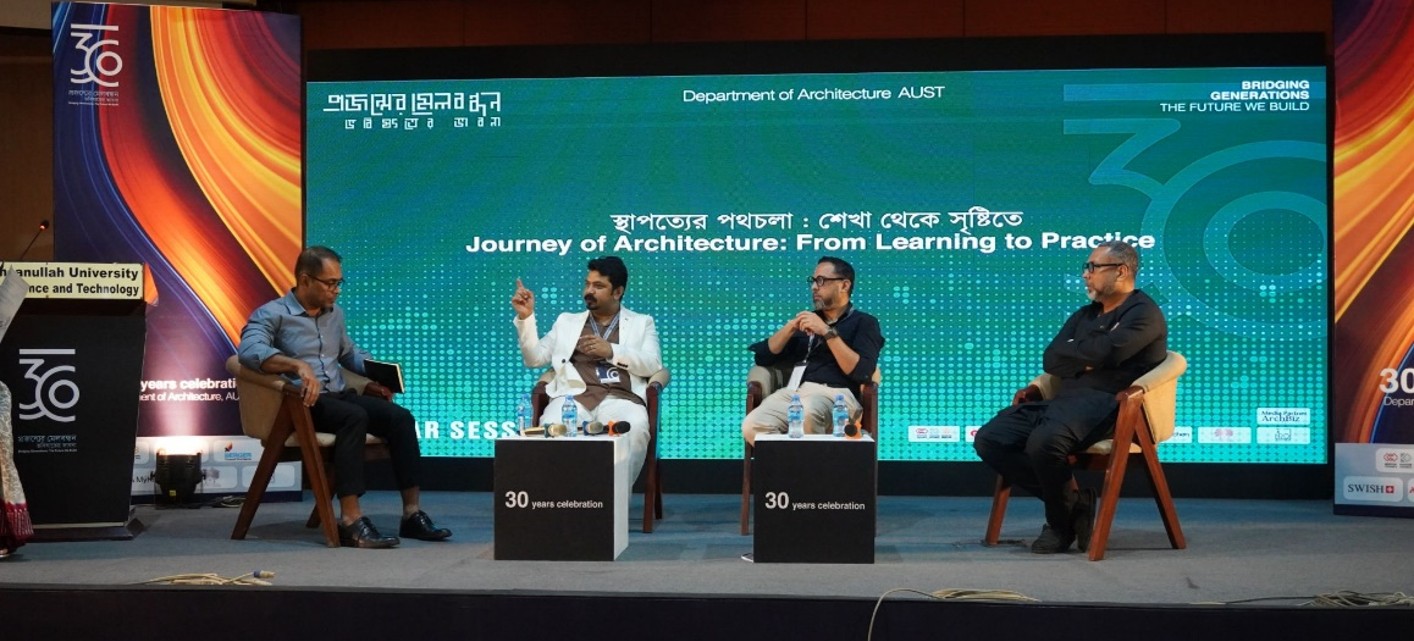
The discussion brought together the speakers' varied experiences of moving from architectural education into practice, connecting questions of context, vernacular knowledge, environmental responsibility, professional constraints, and design thinking. In keeping with the session's theme, the conversation positioned architectural education not as a completed stage but as the foundation of an ongoing process in which architects continually reinterpret, test, and adapt what they have learned through the realities of practice.
The second session thus extended the central idea of the 30th-anniversary celebration: that the journey of architecture is shaped across generations, with knowledge moving continuously between the studio, the profession, and the communities that architecture ultimately serves.
Crest Handover
At the close of the morning session, the Seminar Committee along with the Head of the Department of Architecture presented honorary crests to each of the distinguished speakers in recognition of their contributions to the day's programme and to the broader field of architectural education.
Conclusion
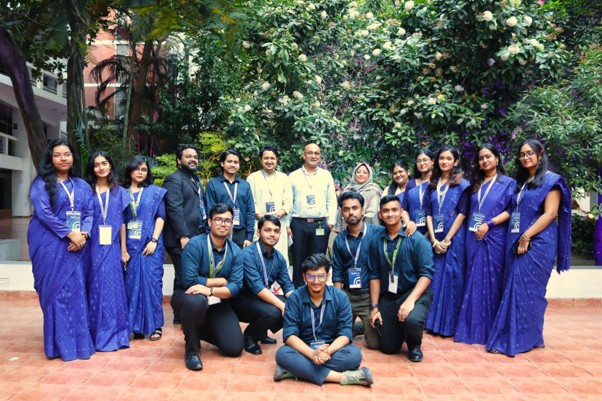
The Seminar Committee states its honor in contributing to the 30 Years Celebration of the Department of Architecture, Ahsanullah University of Science and Technology (AUST), under the leadership of Convener Prof. Dr. Shehzad Zahir, Co-Convener Dr. Ayasha Siddiqua, and Committee Member Ar. Shahriar Mahmud. The Committee extends its sincere gratitude to the Department of Architecture, AUST, and to all faculty members, students, alumni, guests, volunteers, and other contributors whose dedication, support, and collaboration made the seminar a success. The Committee deeply appreciates the collective effort that made this milestone celebration meaningful and memorable.
Faculty of Architecture and Planning
Ahsanullah University of Science and Technology
141 & 142, Love Road, Tejgaon Industrial Area, Dhaka-1208
Tel. (8802) 8870422, Ext. 107, 114, Fax : (8802) 8870418
Email: info@aust.edu, regr@aust.edu